
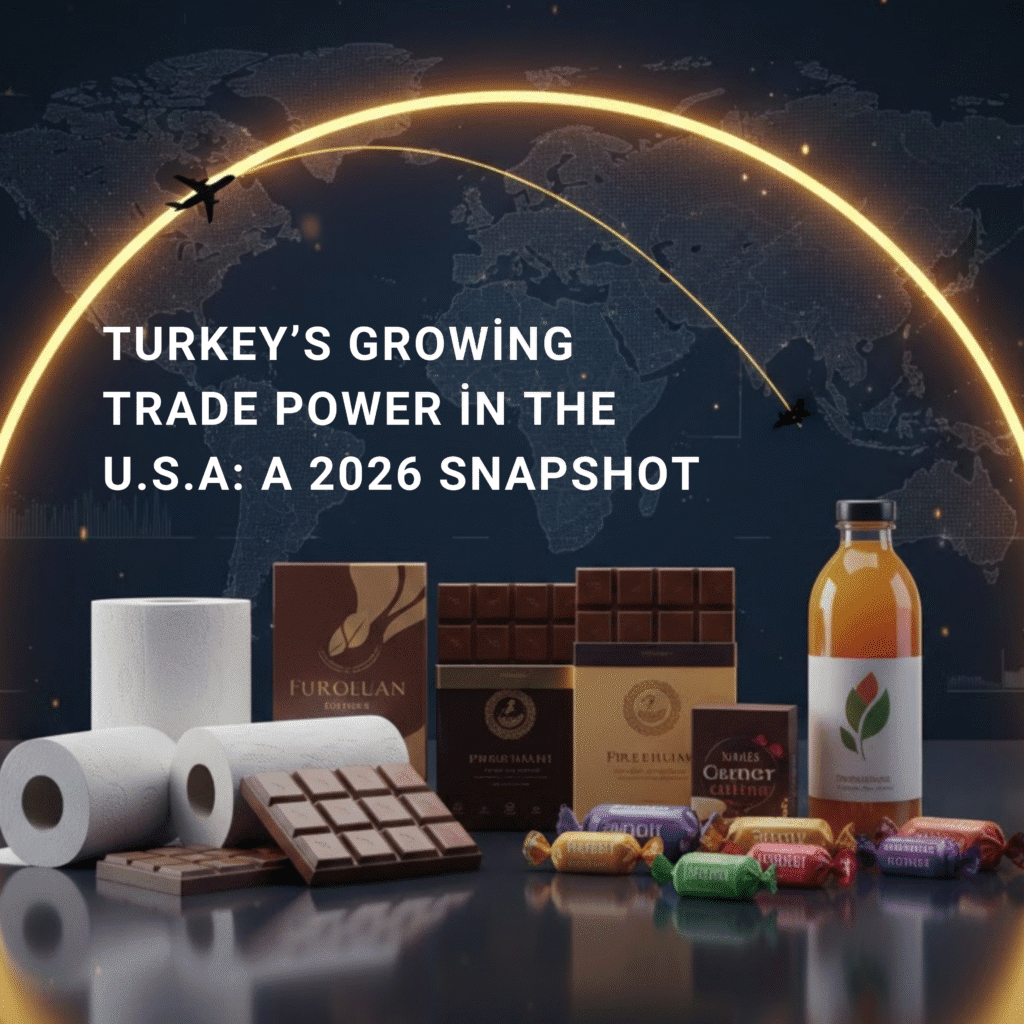
Over the past two decades, Turkey has quietly transformed into one of the most dynamic manufacturing economies in its region. The numbers make this transformation clear.
Global imports increased from approximately $6.3 trillion in 2001 to over $22 trillion by 2021. The United States remains the world’s largest importer, accounting for nearly $3 trillion annually—more than 13% of global import demand. This scale alone makes the U.S. the single most important target market for any export-driven economy.
Turkey’s export performance during this period has been equally notable. The country surpassed $225 billion in annual goods exports and exceeded 1% of global export share—a structural milestone that reflects industrial maturity rather than temporary growth.
In 2026, the macroeconomic alignment between Turkey and the United States creates a strategic opportunity. Turkey’s GDP is projected to exceed $1.2 trillion, with stable growth around 3%. Despite recent inflation fluctuations, Turkish exporters maintain strong competitiveness in USD terms due to currency dynamics. For U.S. buyers facing margin pressure and inflation-sensitive consumers, this matters.
But the real growth engine between Turkey and the U.S. is not heavy industry. It is fast-moving consumer goods (FMCG).
Why FMCG Leads the Growth Story
Categories such as confectionery, chocolate, beverages, and tissue products offer:
- High repeat purchase cycles
- Fast retail turnover
- Private label compatibility
- Scalable distribution potential
The U.S. confectionery market alone exceeds $40 billion annually. Chocolate imports represent a significant portion of this volume, while sugar confectionery continues to grow across private label and specialty segments.
Turkey is one of Europe’s leading confectionery producers, with advanced capabilities in hard candy, gummies, filled chocolate bars, wafers, and seasonal lines. The competitive edge lies in the cost–quality balance: Turkish manufacturers can match European production standards while offering more competitive pricing structures.
For U.S. retailers seeking margin improvement without sacrificing quality, this balance is strategically attractive.
Beverage Exports: Natural Advantage
The U.S. beverage market is evolving toward natural, fruit-based, and functional products. Turkish producers benefit from strong agricultural integration, supporting exports such as pomegranate juice, cherry nectar, apricot beverages, mineral water, and energy drinks.
As American consumers increasingly value natural ingredients and Mediterranean origin products, Turkey’s positioning becomes more relevant.
Private label beverage programs are expanding across regional chains, providing entry opportunities for agile producers capable of adapting packaging and FDA labeling requirements.
Tissue and Toilet Paper: Stability Matters
The pandemic highlighted vulnerabilities in tissue supply chains in the U.S. market. Toilet paper shortages revealed the risks of concentrated sourcing.
Turkey ranks among Europe’s major tissue producers, operating modern high-capacity production lines. For U.S. buyers seeking diversified supply, Turkish tissue exporters offer production scale, flexible packaging formats, and competitive pricing.
While freight-sensitive, tissue exports become viable when supported by efficient logistics and warehouse presence in the U.S.
Supply diversification is no longer optional—it is risk management.
The Real Differentiator: Execution
Export success in the U.S. market depends on more than competitive pricing.
Retail chains require:
- On-time delivery
- Inventory continuity
- Label compliance
- Domestic distribution coordination
Without operational execution inside the U.S., even strong products struggle to scale.
This is where structured market entry models matter. Turkish production strength must be supported by U.S.-based warehousing, sales management, and distribution strategy.
The shift from exporter to market participant defines the next phase of growth.
2026: A Structural Opportunity
Turkey offers a rare combination in global sourcing:
- Industrial modernization
- Competitive USD pricing
- EU-aligned standards
- Geographic proximity to Europe and the Middle East
- Flexible production for private label
In a global environment defined by supply chain diversification, Turkey is increasingly viewed not as an alternative supplier—but as a strategic partner.
For confectionery, chocolate, beverages, and tissue products, the drivers are aligned:
- The U.S. remains the largest consumer market.
- Retailers seek diversified sourcing.
- Private label demand continues to grow.
- Cost pressure increases the need for competitive suppliers.
Turkey has the production strength.
The U.S. has the demand scale.
The opportunity in 2026 lies in connecting the two through disciplined execution.
If you want to transform Turkish manufacturing power into sustainable shelf presence in the United States, now is the time to build the right operational bridge and position your products where they belong — in the world’s largest consumer market.
Contact Us: https://batabagroup.com/contact/

