
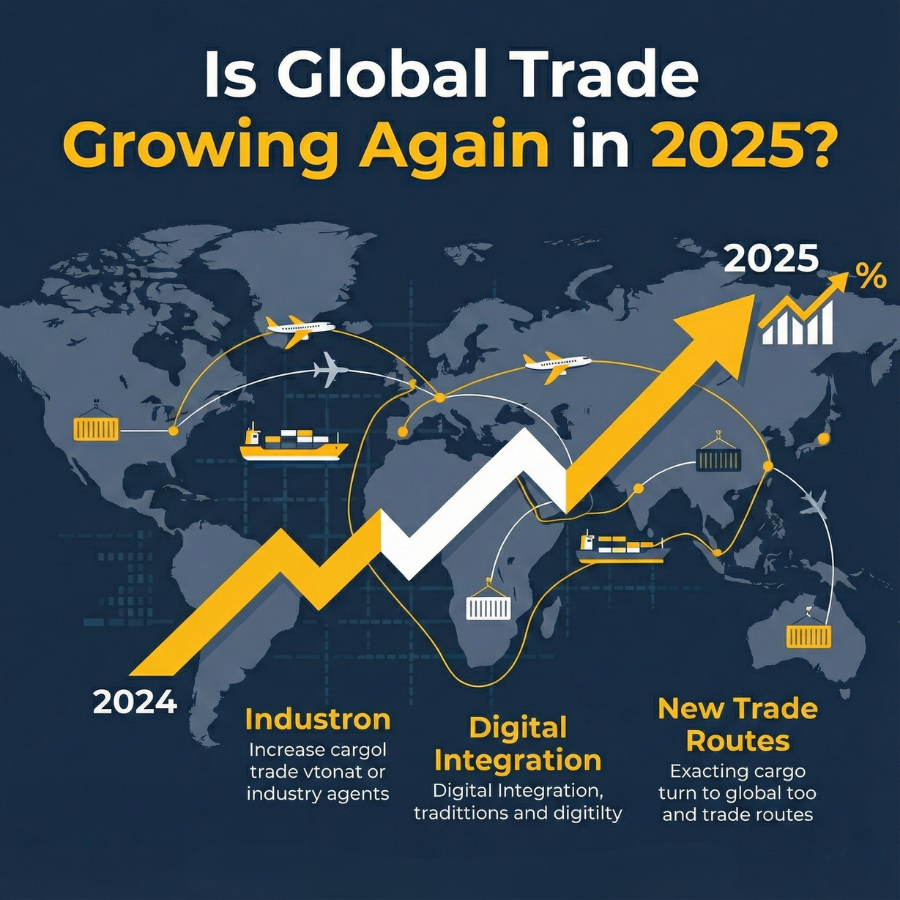
After years of disruption caused by the pandemic and geopolitical uncertainty, global merchandise trade is entering a new phase of recovery and stabilization. According to the latest projections published by the World Trade Organization (WTO), world trade volumes are expected to continue growing through 2025, with more cautious but still positive momentum toward 2026.
This shift has important implications for exporters, buyers, and logistics operators involved in cross-border trade, particularly in fast-moving categories such as food, confectionery, beverages, and consumer goods.
A Clear Recovery Path After 2020
The WTO chart below illustrates how global merchandise trade volume has evolved since 2019 (indexed at 100):
- 2020 shows a sharp contraction, reflecting the impact of COVID-19 on supply chains and demand.
- 2021–2022 mark a strong rebound as global markets reopened.
- 2023 indicates a slowdown, driven by inflation, tighter financial conditions, and regional disruptions.
- 2024–2025 signal renewed growth, with global trade volumes surpassing pre-pandemic levels.
- 2026 is projected to grow at a slower pace, suggesting a transition toward a more disciplined and efficiency-driven trade environment.

Chart 1: World merchandise trade volume growth, 2019-2026
Index, 2019=100 and annual % change
Sources: WTO for historical trade statistics. WTO Secretariat estimates for trade forecasts.
This trajectory confirms that global trade is no longer in crisis mode—but it is also no longer forgiving. Growth is returning, but it favors well-structured, compliant, and operationally strong supply chains.
Which Regions Are Driving Trade Growth?
A closer look at regional contributions reveals several key insights:
- Asia is the largest contributor to global trade growth in both 2024 and 2025, reinforcing its role as the world’s manufacturing and sourcing hub.
- Europe provides a steady but moderate contribution.
- North America shows more volatility, reflecting shifting demand patterns and tighter regulatory environments.
- Latin America and the Rest of the World add incremental but meaningful support to global growth.
For companies operating between Türkiye, the U.S.A., Mexico, and Colombia, this matters because it highlights where demand is expanding—and where operational precision is required.
What This Means for Food & FMCG Shipments
As global trade volumes grow, competition intensifies. Buyers are no longer just asking “Can you ship?”—they are asking:
- Can you ship on time?
- Can you ship compliantly?
- Can you ship at scale without disruption?
In regulated markets like the U.S.A., Mexico, and Colombia, growth does not automatically translate into opportunity unless shipments are supported by:
- Correct labeling and regulatory alignment
- Reliable warehousing and distribution
- End-to-end logistics coordination
This is where many exporters struggle—and where execution becomes more valuable than strategy alone.
From Growth to Execution: The New Trade Reality
The WTO data makes one thing clear:
📈 Global trade is growing again—but only efficient operators will benefit from it.
As growth moderates after 2025, success will depend less on market forecasts and more on operational readiness:
- Shorter lead times
- Fewer compliance errors
- Better inventory positioning
- Smarter regional distribution
For companies sourcing from Türkiye and selling into the Americas, this shift favors partners who can translate trade growth into real shipments, not just reports.
Final Takeaway
The next phase of global trade is not about volume alone—it is about execution under complexity. WTO projections show opportunity, but they also signal a more selective environment where only structured, compliant, and well-coordinated supply chains will scale.
In this new landscape, trade growth belongs to those who can move products efficiently across borders, not just analyze the market from afar.
Ready to Turn Trade Growth into Real Shipments?
As global trade volumes rise, success depends on more than demand — it requires execution, compliance, and operational control.
If you are:
- A buyer or distributor in the U.S.A., Mexico, or Colombia sourcing products from Türkiye, or
- A Turkish manufacturer looking to scale exports into the Americas,
Bataba supports your entire journey — from supplier sourcing and compliance to warehousing, logistics, and market delivery.

