
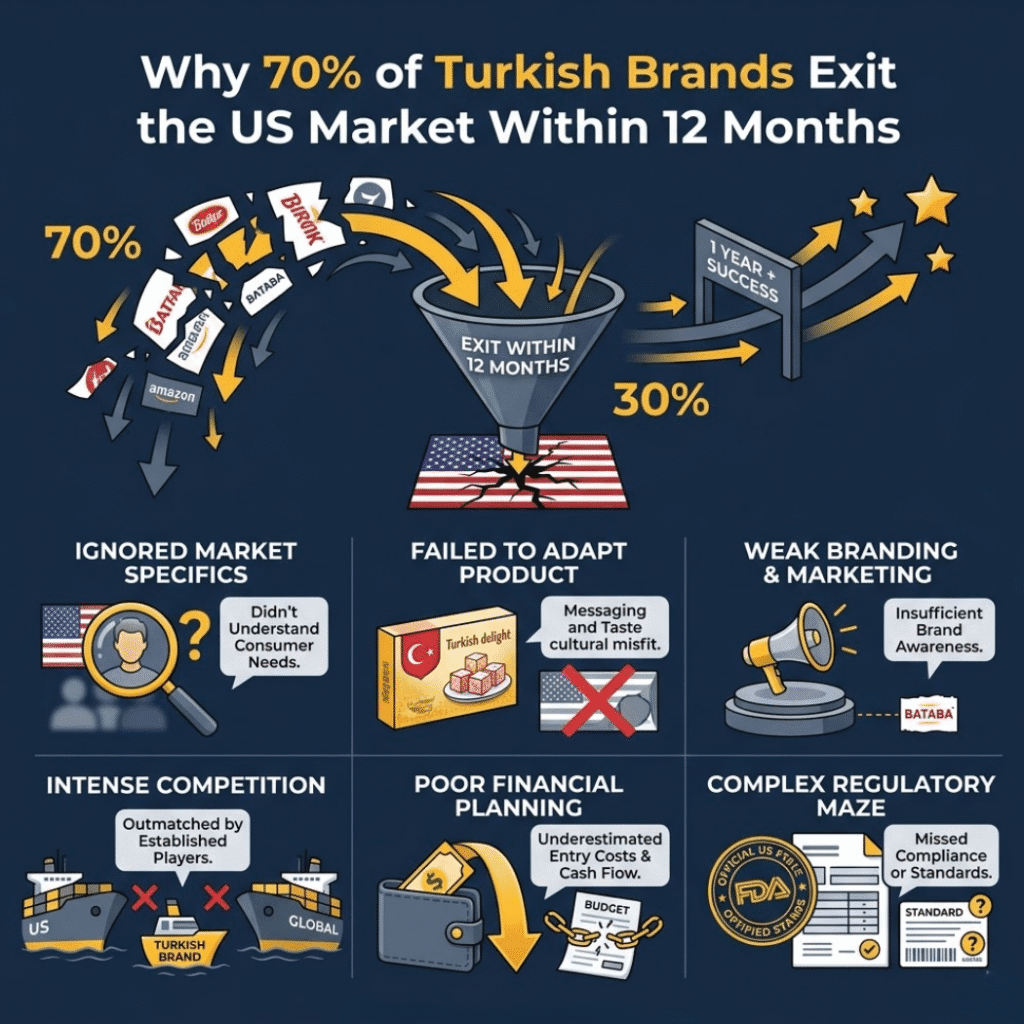
Shipping a container counts as “exporting.” Building a presence in a market is a completely different game. The data shows most Turkish brands confuse the two — and the consequences are brutal.
The Picture at a Glance
The US is the world’s largest consumer market — over $1.5 trillion in annual food and beverage retail sales, roughly 330 million consumers, and the most disciplined supply chain infrastructure on the planet.
Turkey’s annual exports to the US have stabilized at $15-17 billion over the last three years (TİM and TÜİK data). Food, beverage, FMCG, and paper goods make up a significant portion of that figure.
But here’s the uncomfortable truth:
The vast majority of Turkish brands that enter the US market either exit completely within the first 12 months or get stuck in “one-time shipper” mode forever.
The reason is not product quality. It’s the absence of operational infrastructure on the ground.
Section 1: The Brutal Reality of New Products in the US
A long-running study by Nielsen and Catalina has consistently shown one thing: Roughly 70-80% of new FMCG products introduced to US retail shelves are delisted within the first 12 months.
That number applies even to domestic American brands. For foreign brands, the odds are even worse. The reason is simple:
US retailers — Walmart, Kroger, Costco, Albertsons, Publix — run a process called SKU rationalization every 6-12 months. Underperforming products are quietly removed from the assortment, no second chances.
Here’s what it actually takes for a product to stay on the shelf:
| Factor | What US Retailers Expect |
|---|---|
| Sell-through velocity | Weekly units per store, above category average |
| Stock continuity | 95%+ in-stock rate (delays are not tolerated) |
| Trade marketing support | 5-15% of annual revenue allocated to promotions |
| Customer feedback | Return and complaint rate under 2% |
| Category contribution | Must accelerate growth in the existing category |
A single gap in any of these five categories is grounds for delisting.
Most Turkish brands can’t even meet the first three. The reason is always the same: no on-the-ground operation in the US.
Section 2: The Distributor Trap
Over 90% of Turkish brands entering the US in their first year say some version of this:
“We found a great distributor — they’ll handle the rest.”
This sentence has destroyed more Turkish brands in the US than any other strategic mistake in the past five years.
Why? Because the role of a distributor in the US is fundamentally different from what it is in Turkey.
In Turkey, a distributor typically:
- Buys your product
- Places it with retailers
- Handles collections
- Manages the relationship
In the US, a distributor:
- Helps you get listed with chains
- Handles physical logistics and distribution
- Does not actively sell your product
- Sell-out responsibility stays with you
This distinction is critical. In US retail, being “in” (on the shelf) and getting “out” (off the shelf into a customer’s basket) are two completely different processes. Distributors only solve the first half.
If there’s no one behind the scenes tracking sell-out, managing shelf visibility, investing in trade marketing, and monitoring customer feedback — your distributor will quietly drop you within 6-9 months. Because your underperformance hurts their own KPIs.
The common pattern among successful foreign brands in the US: They work with distributors, but they run the operation themselves.
Section 3: FDA — The Most Expensive Thing You’re Ignoring
The most common strategic mistake we see Turkish manufacturers make is treating FDA compliance as a “we’ll fix it later” item.
Some hard numbers:
- The FDA is the world’s largest food regulatory authority, with over 250,000 registered food facilities.
- An FDA Food Facility Registration for a Turkish manufacturer takes 2-6 weeks on average — assuming the prep work is correct.
- Products without FSVP (Foreign Supplier Verification Program) compliance are automatically rejected at customs.
- Once a product lands on FDA’s “Import Alert” list, removal from that list takes 6-18 months.
Here’s an even harsher reality:
Major US retail chains (Walmart, Kroger, Whole Foods, Costco) treat FDA compliance as a non-negotiable listing requirement during supplier onboarding. A single missing certification can cancel a listing that took months to negotiate.
FDA compliance is not “a formality you’ll handle later.” It’s the lock on the front door of the market.
Most Turkish brands leave it until the last minute — and watch the door close.
Section 4: The Logistics Reality — 21 Days vs 3 Days
The average reorder cycle for US retailers is 7-14 days. In some chains, it’s as tight as 3 days.
Now do the simple math:
| Method | Average Lead Time |
|---|---|
| Direct shipment from Turkey | 18-25 days |
| US-based 3PL warehouse | 1-3 days |
If you don’t hold local stock in the US, you cannot fulfill the second order when it arrives. And every order you can’t fulfill pushes the buyer toward a competitor.
It gets worse: an “out of stock” status in US retail can be grounds for terminating your annual contract. Walmart’s official supplier scorecard penalizes any vendor whose in-stock rate drops below 95%.
A US-based warehouse is not a luxury. It’s the price of admission.
Section 5: A Real Scenario — One Turkish Brand’s 18-Month Transformation
Let’s walk through an anonymized example. A well-known Turkish chocolate manufacturer spent two years shipping containers to the US. The product was high quality, the price competitive, the packaging at international standards.
Year 1-2 results:
- Worked with 6 different small distributors
- None of the relationships lasted longer than 9 months
- Listed in 3 different national chains, all 3 delisted them
- Annual revenue: ~$400,000 (unsustainable, surprise orders only)
Then the strategy changed. Here’s what they did:
- 3PL agreement in New Jersey → lead time dropped from 21 days to 2 days
- FDA Food Facility Registration + FSVP compliance → onboarding barriers cleared at 2 national chains
- Bilingual sales manager on the ground → distributor + chain relationships managed from one point
- 12% of annual revenue allocated to trade marketing → shelf visibility, in-store promotions, sampling campaigns
Results 18 months later:
- Active listings in 4 national chains
- Predictable, recurring monthly orders (no more surprises)
- Annual revenue: ~$2.8 million
- The manufacturer made the decision to open its own US office
None of these steps were about “making a better product.” Every single one was about building an operation.
Section 6: The 5 Conditions for Sustainable Market Entry
After working with dozens of Turkish brands, here are the five conditions that consistently separate the long-term winners from the short-term casualties:
1. On-the-ground operational infrastructure A physical presence in the US — warehouse, office, or local partner. Remote management does not work.
2. Proactive FDA compliance All regulatory documentation in place before the first container ships.
3. Trade marketing investment At least 8-12% of annual revenue allocated to local marketing, promotions, and shelf visibility.
4. Self-managed sell-out tracking Don’t rely on the distributor. Track your own weekly sell-out data.
5. Single-point relationship management A field partner who can handle distributor, retailer, logistics, and customer relationships from one point of contact.
If even one of these five conditions is missing, the US will remain “a market you tried” — not “a market you won.”
Conclusion: Exporting Is Not the Same as Operating
Turkey’s exports to the US grow every year. But a significant portion of that volume comes from one-time shipments — not from sustainable, recurring, brand-building operations.
For Turkish manufacturers who want to win in the US for the long term, there are two real options:
Option 1: Open your own US office. Timeline: 18-36 months. Cost: $500K-$2M+. Risk: high.
Option 2: Work with a partner who runs the operation on the ground for you. Timeline: 3-6 months. Cost: variable, performance-based. Risk: shared.
Bataba & Co was built to deliver Option 2.
We are not consultants. We don’t write reports and disappear. We take on the full operational load on the ground in the US — warehouse, logistics, FDA, sales, trade marketing, sell-out tracking, and account management — so Turkish manufacturers can actually build a business in the US, not just ship to it.
Because the difference between “shipping a product to the US” and “existing in the US” is one thing: someone running the operation on the ground.
💬 Next Step
Want to talk about where your US operation stands today?
In a free 30-minute strategy session, we’ll cover:
- A risk map of your current US operation
- The 3 most critical gaps holding you back
- The first 90-day action plan for sustainable growth
Book a Free Strategy Session →
- TİM (Turkish Exporters Assembly) — Annual export reports
- TÜİK (Turkish Statistical Institute) — Foreign trade statistics
- Catalina — CPG Innovation Failure Studies
- Nielsen — New Product Innovation Reports
- FDA — Food Facility Registration & FSVP Guidelines
- US Census Bureau — Retail Trade Reports
- Walmart Supplier Standards (public documentation)

